
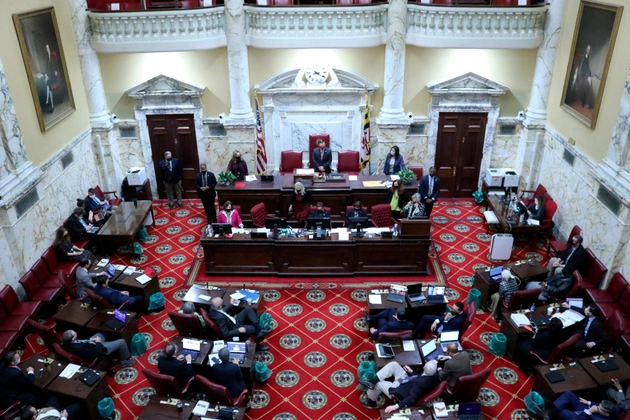
Maryland’s only House Republican, Andy Harris, has declared his intention to pursue legal action against state Democratic leaders if they proceed with plans to adopt a new congressional map that could eliminate his district. The Maryland House of Delegates is scheduled to consider initial steps toward redrawing the state’s congressional boundaries, a move that would favor Democrats in every district. If enacted, the proposal could cost Harris his seat in Congress, where he currently serves as chairman of the House Freedom Caucus representing part of the state. The redistricting initiative, driven by Maryland Governor Wes Moore’s Redistricting Advisory Commission, has drawn sharp criticism from Harris. Speaking to The Global Brief, Harris remarked on the commission’s approach, saying, “His partisan gerrymandering commission certainly lived up to its name. They literally drew the district across a five-mile-long Bay Bridge to go into two other pieces of two other different counties.” The new map’s design has been a subject of controversy even among Democrats, with Senate President Bill Ferguson describing it as “objectively unconstitutional,” a condemnation Harris highlighted in his own critique.
Governor Moore is scheduled to testify before a committee at the State House in Annapolis on the day the House panel is expected to vote on whether to advance the new map for a full House of Delegates vote. Recently, Moore met with House Democratic Leader Hakeem Jeffries of New York at the U.S. Capitol to discuss the ongoing redistricting efforts. This collaborative approach underscores the Democratic leadership’s commitment to reshaping congressional districts in their favor ahead of the forthcoming elections. Maryland’s situation reflects a broader national trend of partisan battles over redistricting following the 2020 census. Redrawing congressional maps has become a highly contentious issue across multiple states, with both parties seeking to secure electoral advantages. Texas Republicans, for example, have already approved a new map potentially adding five GOP seats in the U.S. House of Representatives, while California voters passed a referendum to redraw maps favorably for Democrats. Similarly, Democrats in Virginia are considering changes to make their map more advantageous, and North Carolina’s Republicans recently passed a new district plan that could jeopardize the state’s lone Democratic congressional seat.
The Maryland case highlights the ongoing legal and political clashes over redistricting practices in the United States. Harris’s threat to bring the matter to court signals an expected litigious response if the proposed map moves forward. As the process continues, the state’s legislative leaders and courts will play critical roles in determining how Maryland’s electoral boundaries are ultimately drawn, with significant consequences for congressional representation in the next election cycle.