
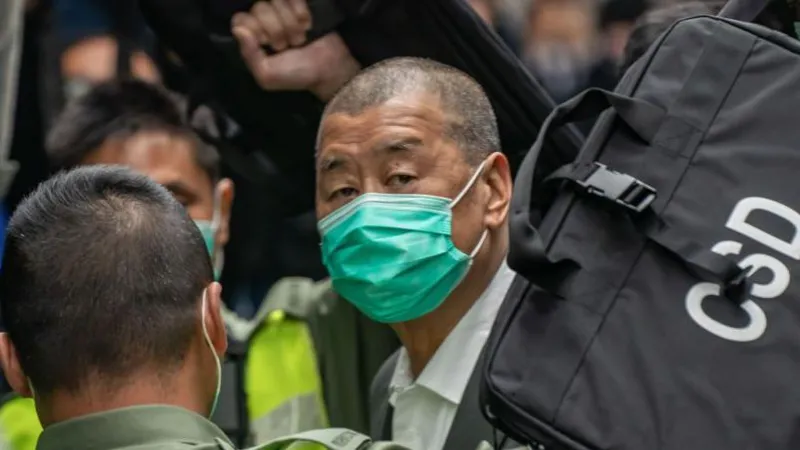
Jimmy Lai, a prominent Hong Kong media tycoon and vocal critic of Beijing, has been sentenced to 20 years in prison after being found guilty of colluding with foreign forces under Hong Kong’s national security law. The verdict was delivered on Tuesday, concluding a trial that centred on allegations that Lai had conspired to invite foreign sanctions against Hong Kong and mainland China, in violation of the sweeping legislation introduced by Beijing in 2020 to curb dissent. The trial unfolded in a Hong Kong court, where Lai was also convicted of fraud-related charges, contributing to the total two-decade prison term imposed.
The prosecution’s case was grounded in evidence presented that Lai had maintained extensive contacts with overseas officials and media, lobbying for international support to condemn Beijing’s policies in Hong Kong. The national security law, enacted on 30 June 2020 by China’s National People’s Congress, criminalises acts deemed to endanger national security, including secession, subversion, terrorism, and collusion with foreign entities. This legislation significantly altered the legal framework governing Hong Kong, a special administrative region since 1997, reducing the scope for political activism and criticism.
During the court proceedings, Lai’s defence argued that his actions fell within the rights of free speech and advocacy, but the judge found the evidence sufficient to convict on all counts. The decision reflects the stringent application of the national security law by Hong Kong authorities and Beijing, which has led to the detention of numerous pro-democracy activists and critics since 2020. Lai’s sentencing marks one of the most high-profile cases under this law, underscoring the shrinking space for dissent in the city.
Following the sentencing, Lai’s family issued a statement describing him as a “martyr” who had suffered for his beliefs. They said Lai remained defiant and would “die a martyr,” reaffirming his commitment to democratic principles despite the harsh legal repercussions. Lai, who founded the now-defunct Apple Daily newspaper, was once one of Hong Kong’s most influential media figures, known for his outspoken opposition to Beijing’s increasing control over the territory.
Apple Daily was forced to close in 2021 after police froze its assets under the national security law, effectively silencing one of the city’s last major pro-democracy media outlets. Lai has been in custody since December 2020, following his initial arrest on charges related to the organisation of mass protests in 2019 that challenged the Hong Kong government and Beijing’s authority. His imprisonment is seen by many international observers and rights groups as a symbol of the deteriorating freedoms in Hong Kong.
The national security law grants law enforcement broad powers to probe and prosecute those accused of activities that Beijing considers subversive or threatening to state sovereignty. Trials under this legislation are often held behind closed doors or subject to strict limitations on legal defence and reporting, justified by authorities as necessary for safeguarding national security. In Lai’s case, the court proceedings extended over several months, with much of the evidence classified or restricted.
Hong Kong’s judiciary, while maintaining operational independence, has increasingly faced scrutiny over its role in enforcing the national security law and balancing local legal traditions with the imperatives of Beijing’s policy. The enhanced legal measures have led to a significant shift in the city’s political and media landscapes, curbing large-scale protests and critical reportage.
As of the sentencing, Jimmy Lai remains in custody, and his family’s declaration highlights the enduring tensions between the city’s pro-democracy activists and the Chinese government. The case illustrates the legal and political transformations which have reshaped Hong Kong since the national security law’s enactment, redefining the boundaries of permissible public discourse and political expression.