
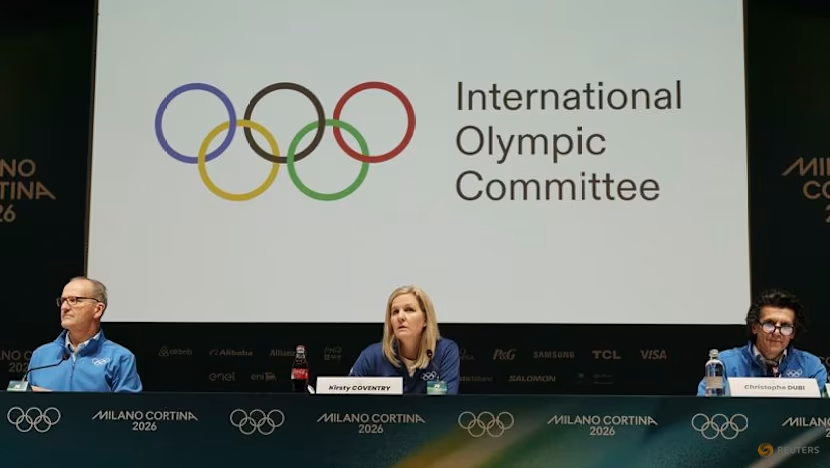
The International Olympic Committee (IOC) alongside leading sports organisations has reached a consensus on a new policy governing the participation of transgender athletes in competitive sports. The decision, finalised in early February 2026, follows extensive consultations and aims to balance inclusion with fairness across all levels of competition. This updated policy replaces previous guidelines that had been deemed inconsistent and lacking clarity by several member federations and athletes.
The new framework introduces eligibility criteria based on a combination of hormonal levels and the athlete’s legal gender status. Specifically, it establishes thresholds for testosterone concentration in blood over a defined period to regulate participation in women’s categories, reflecting scientific input and expert recommendations. The policy was developed under the authority of the IOC’s Gender Equality Review Project and is intended to provide a unified approach for international sports governing bodies to adopt or adapt.
The process leading to this agreement involved detailed negotiations among the IOC, the World Athletics Federation, the International Swimming Federation, and other major stakeholders. Discussions were convened over the past 18 months, involving medical experts, legal advisors, athlete representatives, and human rights advocates. The consensus emerged after careful review of scientific evidence on physiological differences and the impact on competitive equity.
According to IOC President Thomas Bach, the consensus “represents a significant step forward in ensuring both fairness and inclusion, respecting the human rights of all athletes while preserving the integrity of sport.” The new policy requires transgender women to maintain their testosterone levels below 5 nanomoles per litre for at least 12 months prior to participation in women’s competitions. It also includes provisions for regular monitoring and establishes appeal mechanisms for athletes who wish to contest decisions or demonstrate eligibility under exceptional circumstances.
This policy applies initially to Olympic-level competitions, with the IOC encouraging other sports organisations to align their regulations accordingly. National federations will be responsible for implementing the rules and overseeing compliance, with the IOC providing guidance and support. The IOC emphasised that the policy aims to be adaptable as new scientific findings emerge and as societal understandings evolve.
The new standards mark a departure from the IOC’s 2015 framework, which focused more narrowly on hormone treatments without standardized monitoring protocols. By clarifying procedures and setting measurable eligibility benchmarks, the IOC seeks to reduce disputes and promote transparency. This approach reflects a broader shift within international sports governance to develop evidence-based and human rights-compliant policies.
Representatives from various sports bodies welcomed the announcement, noting the comprehensive consultations that informed the policy. Some advocates for transgender inclusion acknowledged the compromise nature of the criteria but recognized the value in consistent international rules. Conversely, some athletes and officials expressed concerns about whether the new thresholds adequately address competitive advantages or the complexity of gender identity.
The IOC and partner organisations have committed to ongoing review of the policy’s implementation and impact. Data collection and athlete feedback will be integral to potential future refinements. The next scheduled evaluation is set for 2028, coinciding with the upcoming Olympic Summer Games, to assess efficacy and fairness.
This consensus represents a landmark moment in the regulation of gender categories in sport, aiming to harmonize inclusion efforts with competitive integrity on a global scale and providing a clearer framework for athletes navigating eligibility in an evolving landscape.