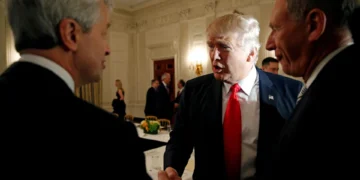































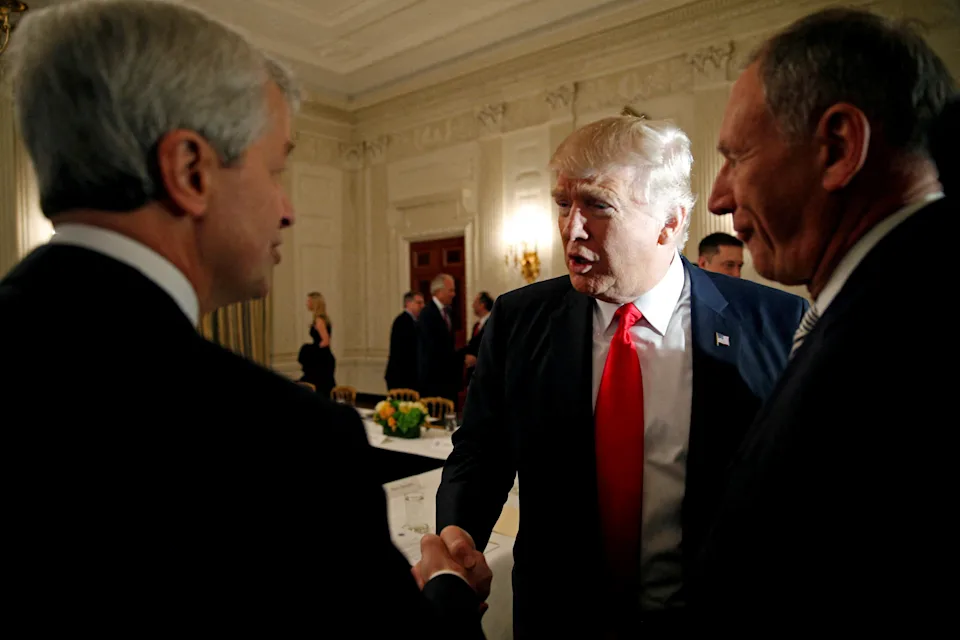
Bank of America and JPMorgan Chase have each committed to contributing $1,000 per participating employee to accounts supporting Donald Trump, as part of a workplace-based political fundraising initiative. The move comes amid a broader push by Trump’s campaign to deepen financial backing through structured payroll-deduction programs linked to major employers.
According to data from the U.S. Federal Election Commission, corporate-associated political fundraising accounted for more than $5.2 billion in the 2020 election cycle, with employee-driven payroll contribution schemes representing a growing share of small-donor activity. Matching programs similar to those announced by the two banks have been shown to increase participation rates by 30–45%, based on prior campaign finance studies, by lowering the effective cost of individual donations.
Trump’s campaign has emphasized that mobilizing workers in the financial sector is strategically important, noting that finance and insurance employees contributed over $1.9 billion to federal candidates between 2016 and 2024. Campaign representatives describe the employer-facilitated contributions as a mechanism to convert passive supporters into recurring donors, strengthening long-term fundraising capacity ahead of future electoral contests.
Under the arrangement, employees may voluntarily allocate a portion of their salaries to designated political accounts, after which participating employers provide capped matching contributions. Industry compliance data indicates that over 70% of large U.S. corporations already operate some form of payroll deduction system, though only a minority extend matching mechanisms to political causes due to regulatory sensitivity.
The initiative has reignited debate around corporate influence in partisan politics. Surveys conducted by governance watchdogs show that nearly 58% of U.S. employees express concern that employer involvement in political fundraising may indirectly pressure participation, even when programs are formally voluntary. This has heightened scrutiny from regulators and advocacy groups focused on transparency and corporate governance.
Both banks have stated that the contributions comply fully with existing campaign finance laws, emphasizing that employee consent is mandatory and participation rates are expected to remain modest relative to their combined workforce of more than 430,000 employees globally. Internal projections cited by industry analysts suggest that even 5% participation could generate several million dollars in matched political contributions over a single election cycle.
Campaign officials say the next phase of the strategy involves expanding similar employer-linked fundraising programs across additional sectors, including manufacturing, logistics, and energy. Legal experts note that while the model is currently permissible, rising public attention could lead to tighter disclosure requirements and increased regulatory oversight of corporate political activity.